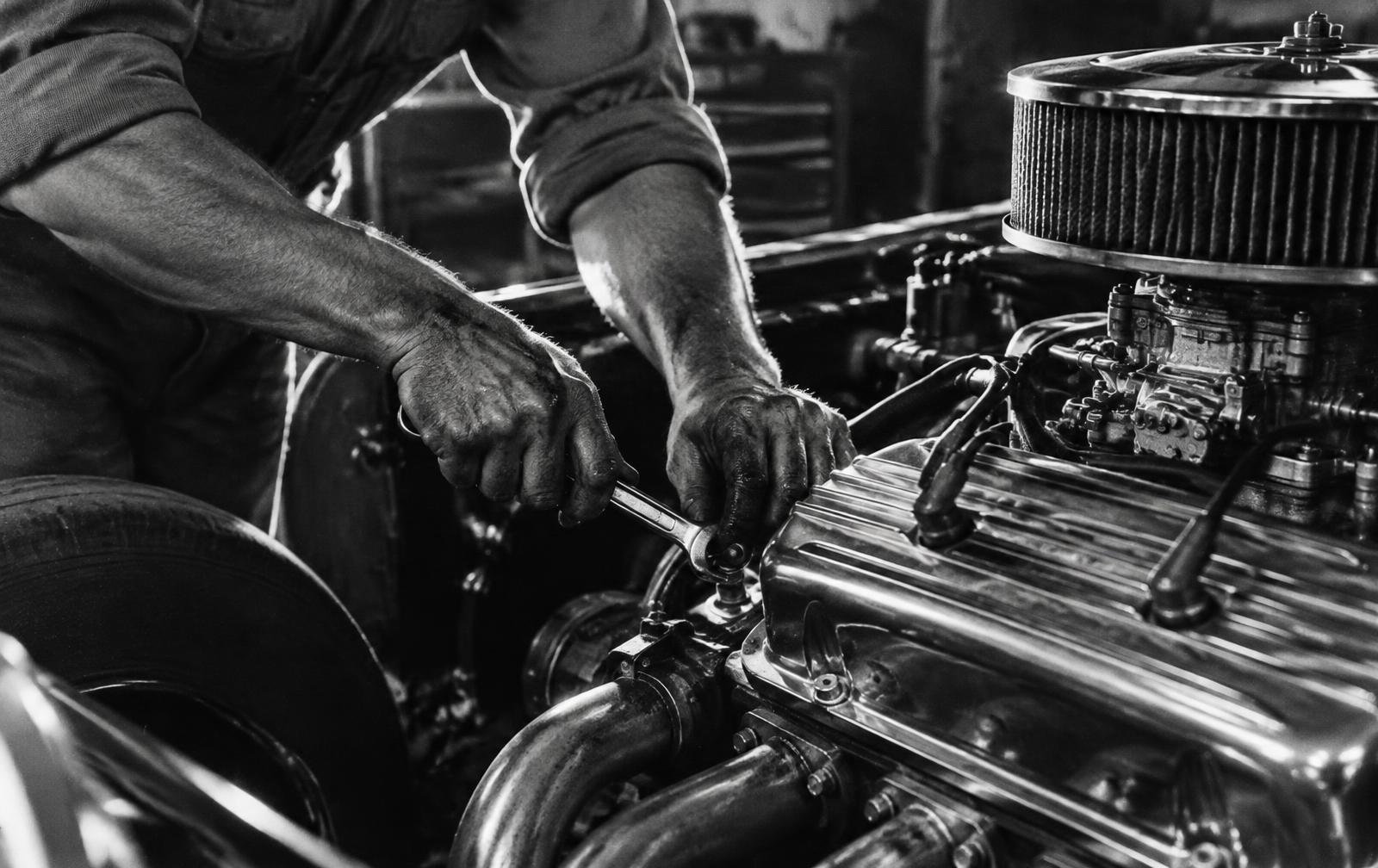
The Overhead-Valve V8 Revolution
Postwar engines from Cadillac, Oldsmobile, Chrysler, and Chevrolet changed what hot rodders could build.
Illustrative image · AI-generated, not a historical photograph
The Ford flathead dominated early hot rodding, but its design limited how much power it could make. In 1949, Cadillac and Oldsmobile introduced modern overhead-valve V8 engines. Chrysler followed in 1951 with its hemispherical-combustion-chamber V8 — the original "Hemi."
In 1955, Chevrolet introduced its 265-cubic-inch small-block V8. Compact, relatively light, and responsive to modification, it became one of the most widely used engines in hot rodding and racing history.
A new market
Each new engine created demand for a new generation of parts: intake manifolds, camshafts, headers, ignition systems, and more. Speed equipment makers who had specialized in the flathead adapted their product lines, and new companies entered the market.
The small-block Chevrolet's influence is hard to overstate. Its basic architecture remained in production for decades and supported an enormous ecosystem of aftermarket parts.
About this story
This is a sample feature prepared for the HotRodHistory.com demonstration. It summarizes widely documented events and contains no quotations attributed to historical figures. Dates and details should be confirmed against primary sources before publication. The image above is an AI-generated illustration, not a historical photograph.
Next story
1963: The Industry Organizes
More from Aftermarket
 Illustration
From Garage to Catalog
How the Model T and the flathead Ford V8 gave rise to the first generation of speed equipment makers.
Read · 6 min Illustration
1963: The Industry Organizes
The founding of SEMA gave speed equipment manufacturers a shared voice on standards, safety, and trade.
Read · 4 min